Four Bar Linkage
We will simulate a four bar linkage and introduce the command for handling
kinematic loops like this. The system will move in the x-z-plane, thus the
revolute joints all rotate around the y-axis of the world. If you want to
try it first, or look at the complete source code, see
fourbar_linkage.py.
As usual, we start with importing PyMbs, creating a model system and adding various parameters. Here, they are the lengths, masses and inertias of the bars to be connected:
from pymbs.input import MbsSystem, diag, pi

world = MbsSystem([0, 0, -1])

# Parameter
l1 = world.addParam("l1", 1)
...
Now we create our additional three bars (world will act as the first bar)
and add the coordinate systems  through
  at the corners:
m2 = world.addParam("m2", 1)
l2 = world.addParam("l2", 4)
I2 = world.addParam("I2", m2 / 12 * l2**2)

m3 = world.addParam("m3", 1)
l3 = world.addParam("l3", 4)
I3 = world.addParam("I3", m3 / 12 * l3**2)

m4 = world.addParam("m4", 1)
l4 = world.addParam("l4", 5)
I4 = world.addParam("I4", m4 / 12 * l4**2)

# Create bodies with coordinate systems
world.addFrame(name="CS_A")
world.addFrame(name="CS_D", p=[l1, 0, 0])

bar2 = world.addBody(name="Bar2", mass=m2, cg=[l2 / 2, 0, 0], inertia=diag([0, I2, I2]))
bar2.addFrame(name="CS_A")
bar2.addFrame(name="CS_B", p=[l2, 0, 0])

bar3 = world.addBody(name="Bar3", mass=m3, cg=[l3 / 2, 0, 0], inertia=diag([0, I3, I3]))
bar3.addFrame(name="CS_B")
bar3.addFrame(name="CS_C", p=[l3, 0, 0])

bar4 = world.addBody(name="Bar4", mass=m4, cg=[l4 / 2, 0, 0], inertia=diag([0, I4, I4]))
bar4.addFrame(name="CS_D")
bar4.addFrame(name="CS_C", p=[l4, 0, 0])

# Insert joints
jA = world.addJoint(world.CS_A, bar2.CS_A, "Ry", pi / 2)
Then we can connect three of them using regular revolute joints:
world.addLoop.FourBar(bar3.CS_C, bar4.CS_C, posture=1)
However, the last one (here its  ) has to be connected using the
command
) has to be connected using the
command addLoop.FourBar to correctly handle the kinematic loop:
world.addVisualisation.Line(bar3, 4)
With the posture parameter, either 1 or -1, you can choose which
solution is being used. Usually, this switches between the bars intersecting or
not.
In the end, we add a line of each of the bars for visualisation, generate our equations of motion and start the GUI:
world.genEquations.Recursive()
world.show("fourbar_linkage")
The result should look roughly like this:
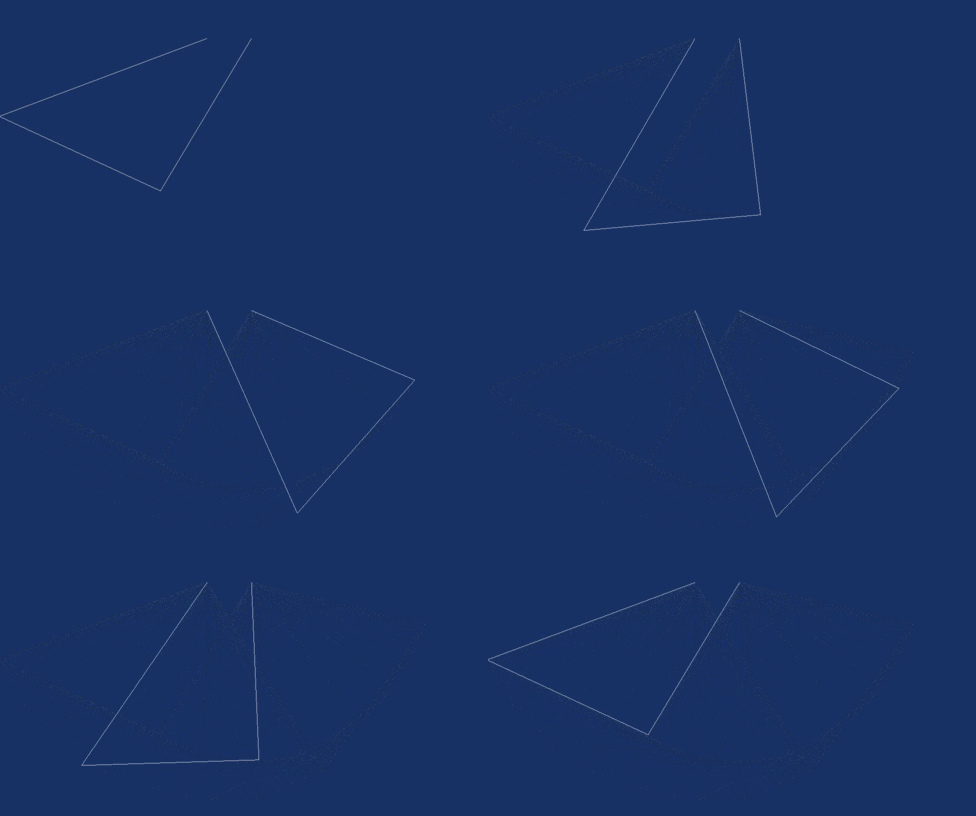
In the end, the complete source looks like this:
"""
Model for a closed loop four-bar linkage.
"""

# Warning: The source code of the examples is quoted in the documentation. If
# you change this file, you'll have to change the corresponding file in the
# documentation (see doc/examples).

from pymbs.input import MbsSystem, diag, pi

world = MbsSystem([0, 0, -1])

# Parameter
l1 = world.addParam("l1", 1)

m2 = world.addParam("m2", 1)
l2 = world.addParam("l2", 4)
I2 = world.addParam("I2", m2 / 12 * l2**2)

m3 = world.addParam("m3", 1)
l3 = world.addParam("l3", 4)
I3 = world.addParam("I3", m3 / 12 * l3**2)

m4 = world.addParam("m4", 1)
l4 = world.addParam("l4", 5)
I4 = world.addParam("I4", m4 / 12 * l4**2)

# Create bodies with coordinate systems
world.addFrame(name="CS_A")
world.addFrame(name="CS_D", p=[l1, 0, 0])

bar2 = world.addBody(name="Bar2", mass=m2, cg=[l2 / 2, 0, 0], inertia=diag([0, I2, I2]))
bar2.addFrame(name="CS_A")
bar2.addFrame(name="CS_B", p=[l2, 0, 0])

bar3 = world.addBody(name="Bar3", mass=m3, cg=[l3 / 2, 0, 0], inertia=diag([0, I3, I3]))
bar3.addFrame(name="CS_B")
bar3.addFrame(name="CS_C", p=[l3, 0, 0])

bar4 = world.addBody(name="Bar4", mass=m4, cg=[l4 / 2, 0, 0], inertia=diag([0, I4, I4]))
bar4.addFrame(name="CS_D")
bar4.addFrame(name="CS_C", p=[l4, 0, 0])

# Insert joints
jA = world.addJoint(world.CS_A, bar2.CS_A, "Ry", pi / 2)
jB = world.addJoint(bar2.CS_B, bar3.CS_B, "Ry")
jD = world.addJoint(world.CS_D, bar4.CS_D, "Ry")

world.addLoop.FourBar(bar3.CS_C, bar4.CS_C, posture=1)

world.addVisualisation.Line(bar2, 4)
world.addVisualisation.Line(bar3, 4)
world.addVisualisation.Line(bar4, 5)

world.genEquations.Recursive()
world.show("fourbar_linkage")